Are Turkish University Degrees Recognized Internationally?
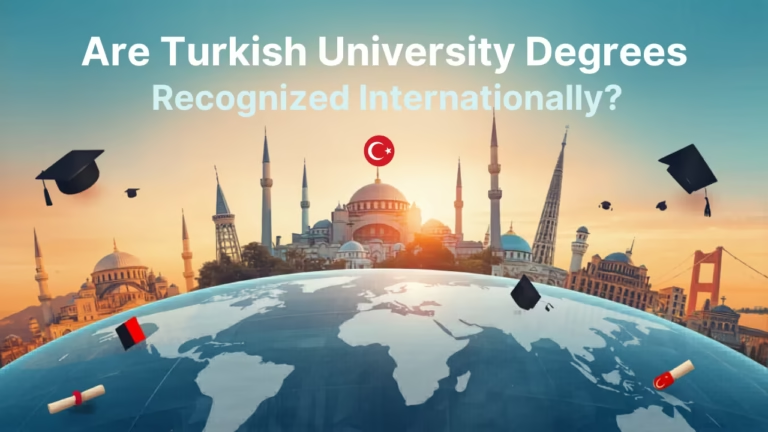
Turkish university degrees occupy a peculiar middle ground in global education hierarchies. They’re neither universally accepted nor broadly rejected, the reality is far more granular than headlines suggest.
When you graduate from Boğaziçi, Middle East Technical University, or Istanbul Technical University, that diploma carries different weight depending on where you’re applying. A recruiter in Berlin recognizes METU’s engineering prestige immediately. A hiring manager in Toronto might require credential evaluation. An admissions officer at Oxford will likely ask for additional English proficiency proof, but won’t dismiss your application outright.
This inconsistency isn’t Turkey-specific. It reflects how international education recognition actually works: through competing frameworks, institutional reputation, and market perception rather than a single global registry.
The Bologna Process: The Framework You Haven’t Heard Enough About
Turkey signed the Bologna Declaration in 2001, formally aligning its higher education system with European standards. This matters more than most people realize, particularly if you’re considering further study in the EU.
The Bologna framework standardized degree levels (bachelor’s, master’s, doctoral), introduced the ECTS credit system, and established quality assurance protocols. If you earned your degree in Turkey post-2001, your transcript structure itself is recognizable to European institutions.
But—and this is crucial—Bologna membership guarantees compatibility, not automatic recognition. Germany’s Kultusministerkonferenz won’t wave through every Turkish degree without review. What Bologna actually does is remove bureaucratic friction. It establishes a common language.
For employment rather than further study, Bologna’s benefit is quieter but real. Your degree structure fits known patterns. Employers don’t waste time decoding credit systems they don’t understand.
YÖK Accreditation:
The Turkish Higher Education Council (YÖK) operates accreditation and recognition systems domestically. Internationally, YÖK recognition carries minimal weight on its own.
What matters is which Turkish institution granted your degree. YÖK categorizes universities into tiers—Foundation universities (like Koç, Sabancı, Bilgi), state universities (METU, Boğaziçi, Ankara University), and newer private and state institutions. These categories correlate loosely with global reputation, but not perfectly.
A graduate from a less-ranked Turkish university might face credential evaluation requirements in Canada or Australia that a top-tier graduate wouldn’t. This reflects not a formal system but employer and institution familiarity.
YÖK’s role is primarily domestic gatekeeping. It ensures quality standards at home. International recognition depends on whether foreign evaluators—whether NACES (North American Evaluators) or UK NARIC—have established protocols for Turkish institutions, and whether those protocols recognize your specific university as meeting their standards.
Where Turkish Degrees Are Actually Recognized

Western Europe: Turkish degrees face moderate friction here. The Netherlands, Germany, and France conduct individual assessments through official credential evaluation bodies, but the process typically takes 4–8 weeks, not years. Employer recognition for STEM and business degrees from top universities is relatively straightforward.
Middle East and Central Asia: Here Turkish degrees punch above their weight. Employers in Dubai, Doha, and Almaty actively recruit from Turkish universities. The METU or Boğaziçi brand resonates because regional employers trust Turkish education quality and cultural proximity reduces perceived risk.
North America: This is where friction peaks. Most employers and institutions require Turkish transcripts evaluated by services like World Education Services (WES) or International Credential Evaluation Service (ICES). Cost runs $150–250 USD per evaluation. The timeline extends 2–4 weeks. Top-tier Turkish university graduates sometimes skip this step when applying to well-known institutions (MIT doesn’t need WES verification to recognize METU), but it’s safer to obtain formal evaluation.
Australia and New Zealand: Similar to North America. Formal credential evaluation through Australian Educational International (AEI) or New Zealand Qualifications Authority is standard protocol. Turkish institutions maintain established reference points in these systems.
UK: Interestingly clearer than some alternatives. NARIC (UK’s credential evaluation body) has established protocols for Turkish universities. Recognition depends partly on whether your program is NQF-aligned, but most recent Turkish degrees meet standards.
Why Top-Tier Turkish Universities Differ
Boğaziçi, METU, Istanbul Technical University, and Sabancı operate differently than tier-2 Turkish universities partly because of international networks, partly because of historical prestige, and partly because employers have internalized their quality markers.
A Boğaziçi engineering graduate applying to a Silicon Valley role bypasses most credential evaluation. Not because of any formal exemption, but because the institution’s reputation is baked into hiring manager knowledge.
Compare this to graduates from newer universities. Same Bologna compliance. Same YÖK oversight. But the credential evaluation step becomes mandatory because the employer hasn’t developed institutional familiarity. You’re buying into an extra 4 weeks of processing and $200 of evaluation cost, not as formal requirement but as practical necessity.
The Employer Acceptance Reality
Here’s what credential evaluation bodies won’t tell you: employer acceptance diverges from formal recognition.
A UK accountancy firm might recognize your Turkish degree formally while preferring candidates with UK A-levels. A German engineering company might evaluate your METU diploma as equivalent to German standards, then require German language proficiency you don’t possess. Formal recognition and actual hiring are parallel, not synonymous, processes.
International employer networks also matter. If your university has exchange partnerships, visiting lecturer arrangements, or alumni networks in specific countries, that informal credibility precedes formal evaluation. It’s why Sabancı graduates find placement in New York easier than their transcript equivalency might suggest.
This is where degree recognition becomes fuzzy. It’s not binary—recognized or not—but gradated by geography, sector, employer size, and employer international exposure.
Practical Costs of Turkish Degree Recognition Gaps
Be realistic about the friction points:
Additional 2–4 weeks of credential evaluation processing delays your job application or study program start date. This compounds if you’re applying to multiple countries simultaneously.
Credential evaluation costs ($150–300 USD per institution, per evaluation service) accumulate when applying across multiple countries or programs.
Visa processing sometimes delays pending credential verification. Some immigration authorities require proof of recognition completion before finalizing study permits.
Some employers in strict-regulation sectors (medicine, law, auditing, architecture) require professional license conversion rather than just degree recognition. Turkish legal qualifications, for example, don’t transfer to UK law without additional qualification routes.
The Three-Year Trend Worth Noticing
Turkey’s international degree recognition has quietly improved. Universities increasingly pursue international accreditation (AACSB for business, ABET for engineering). More programs teach in English. Erasmus+ partnerships expanded significantly post-2015 despite political turbulence. These incremental shifts affect recognition at employer level before they register in formal systems.
If you graduated in 2015 versus 2024, your degree faces measurably different recognition landscapes—partly because institutional capacity improved, partly because employer awareness of Turkish universities expanded.
Takeaways
Turkish degrees are recognized internationally, but inconsistently. Top-tier universities (Boğaziçi, METU, ITU, Sabancı) enjoy stronger global reputation and faster recognition. Tier-2 universities require formal credential evaluation and face longer processing timelines.
Bologna Process membership standardizes structure, not automatic acceptance. Your degree fits familiar frameworks across Europe, removing bureaucratic obstacles but not guaranteeing employment outcomes.
Geographic and sectoral variance matters more than you’d expect. Middle East employers actively seek Turkish graduates. Western European employers recognize degrees after formal evaluation. North American employers typically require credential services. Certain regulated professions require additional licensing beyond degree recognition.
Credential evaluation isn’t optional for most countries. Budget 4–8 weeks and $150–300 per evaluation service if you’re pursuing opportunities outside Turkey. Top-tier universities sometimes receive faster informal recognition, but formal evaluation remains the safe path.
Employer recognition diverges from formal recognition. A degree can be formally recognized in a country while facing hiring reluctance due to employer unfamiliarity. Internship experience and language proficiency often matter more than degree recognition itself.
Your university tier and program discipline shape recognition more than Turkish policy. Engineering and STEM graduates face fewer friction points. Business graduates benefit from international accreditation. Humanities graduates sometimes encounter vague evaluation categories abroad.