Turkey vs. Dubai vs. Malaysia: Which is Better for International Students?
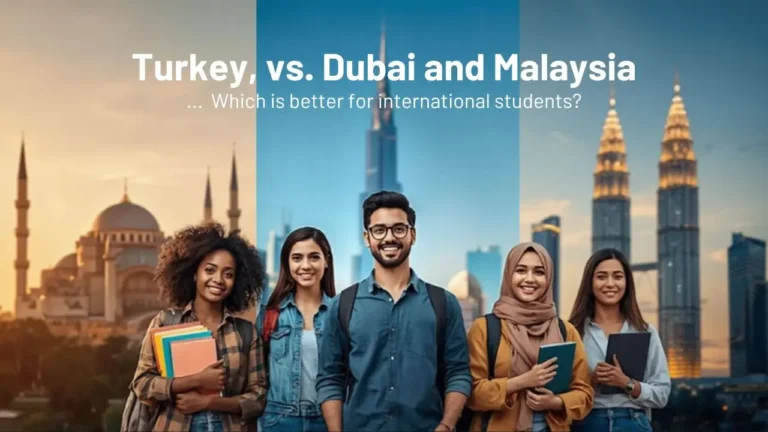
Three Nigerian students sat in our office last month, each holding admission letters from different countries. One had offers from Turkish universities, another from institutions in Dubai, and the third from Malaysian programs. Same field of study, similar budgets, identical question: “Which should I choose?”
This isn’t hypothetical, it’s the most common dilemma we encounter with international students in 2025, particularly those from Africa, South Asia, and the Middle East. Turkey, Dubai, and Malaysia have emerged as the “alternative trio” to expensive Western destinations, each marketing itself aggressively to international students with promises of quality education, cultural compatibility, and affordable costs.
But here’s what the glossy brochures don’t tell you: these three destinations are fundamentally different in ways that matter enormously for your actual student experience, career outcomes, and return on investment. Choosing between them based on marketing materials or surface-level comparisons leads to expensive mistakes—we’ve seen students transfer, struggle, or regret their choices when reality doesn’t match expectations.
This article provides the honest, detailed comparison you need. We’ll examine costs (real numbers, not advertised minimums), academic quality beyond rankings, cultural realities that affect daily life, career prospects post-graduation, and which destination suits specific student profiles. Most importantly, we’ll explain what matters versus what just sounds good.
The Cost Reality: Beyond Advertised Tuition
Let’s start with money, because most students and families make destination decisions primarily on perceived affordability. But “affordable” requires complete cost analysis, not just tuition comparisons.
Turkey’s actual costs: Public university tuition ranges from $400-4,000 annually (most international students pay $1,000-2,500). Private universities charge $4,000-15,000. Living costs in Istanbul run $500-800 monthly; Ankara and other cities $400-600. Health insurance costs $80-150 annually. Total annual budget: $6,000-18,000 depending on university type and lifestyle.
Dubai’s actual costs: University tuition at institutions like American University in Dubai or Middlesex University Dubai runs $15,000-25,000 annually. Living costs are brutal, shared accommodation $600-1,000 monthly, food $400-600 (eating out is expensive; cooking saves considerably), transportation $100-200. Health insurance $500-800 annually. Total annual budget: $25,000-40,000 minimum, and that’s living frugally.
Malaysia’s actual costs: University tuition at institutions like Taylor’s, Sunway, or Monash Malaysia runs $5,000-15,000 annually for international students. Living costs in Kuala Lumpur: $400-700 monthly for accommodation, food, and transport. Health insurance $200-400 annually. Total annual budget: $10,000-22,000.
The pattern is clear: Turkey offers the lowest overall costs, Malaysia falls middle, Dubai is significantly more expensive. But cost alone doesn’t determine value, you need to examine what you receive for these investments.
The hidden cost factor everyone misses: currency stability and transfer fees. Turkish lira volatility can work in your favor if your currency strengthens against it (suddenly everything costs less) or against you if it strengthens. UAE dirham is pegged to USD, meaning stability but also tracking US inflation. Malaysian ringgit is relatively stable. For families managing foreign exchange restrictions or currency devaluations, these dynamics matter enormously.
Academic Quality: The Reputation vs. Reality Gap
Rankings tell part of the story, but lived educational experience tells more.
Turkey’s academic landscape: Top universities like Boğaziçi, METU, Koç, and Sabancı genuinely rival mid-tier European institutions in quality, particularly in engineering, sciences, and business. Faculty often hold PhDs from Western universities and maintain active research. Class sizes vary, top programs have 20-30 students per class; others reach 50-100. Teaching quality is generally solid at ranked institutions, variable at lower-tier universities.
The challenge: Turkish universities typically have less international recognition than their quality merits. A Boğaziçi engineering degree is excellent, but you’ll spend your career explaining where Boğaziçi is. This matters if you care about brand recognition versus actual education quality.
Dubai’s academic reality: Most Dubai institutions are branch campuses of Western universities (Heriot-Watt, Middlesex, Murdoch, etc.) or American-style institutions. Quality varies dramatically, some maintain standards comparable to main campuses, others operate more like satellite operations with limited research and variable faculty.
The advantage: degrees say “Middlesex University” or “Heriot-Watt University” without specifying Dubai campus. This provides Western degree prestige at lower cost than UK/Australia, though employers familiar with international education recognize the difference.
The disadvantage: research opportunities are limited, faculty often rotate rather than establishing long-term presence, and campus facilities can’t match main campuses. You’re paying premium prices for brand names on degrees without the full university experience.
Malaysia’s educational quality: Malaysia has invested heavily in education, attracting branch campuses (Monash, Curtin, Nottingham) and building strong local institutions (Universiti Malaya, Taylor’s, Sunway). Quality generally exceeds price point—you receive solid education at moderate costs.
The advantage: balanced approach combining reasonable quality, moderate costs, and decent recognition especially in Asian markets. Malaysian universities are well-regarded across Southeast Asia, increasingly recognized in Middle East and Africa.
The challenge: Malaysian universities rarely rank in global top tiers. They’re competent, professional, well-managed institutions—but not universities that will make employers or graduate schools immediately impressed. For most career paths, this doesn’t matter. For competitive fields or top graduate programs, it might.
Cultural Fit: Where You’ll Actually Feel Comfortable
This matters more than students initially realize. Feeling culturally alienated or constantly adapting to unfamiliar environments creates stress that affects academic performance and overall wellbeing.
Turkey’s cultural environment: Majority Muslim country with secular state structure and diverse social spaces. Halal food is universal. Prayer facilities are readily available. Alcohol is legal and available but not dominant in all social spaces. Modest dress is common but not required, you’ll see everything from headscarves to shorts. Turkish hospitality culture means locals are generally friendly, though language barriers exist outside major tourist areas.
For students from Middle East, Central Asia, North Africa, or Muslim communities worldwide, Turkey offers cultural comfort without feeling restrictive. For students from other backgrounds, Turkey provides unique cultural immersion without extreme culture shock.
The challenge: gender dynamics can feel different than either conservative Muslim societies or fully Western contexts. Turkey occupies a middle space that sometimes confuses students expecting either/or rather than both/and cultural norms.
Dubai’s cultural landscape: Extremely international, with locals (Emiratis) comprising only about 10% of the population. This creates a unique environment where no single culture dominates, but also where genuine cultural immersion is difficult, you’re in a city of expats, not really experiencing Emirati culture deeply.
Social spaces are diverse but often stratified by income and nationality. Luxury and wealth are highly visible, creating pressure to spend beyond student budgets. Alcohol is available in licensed venues. Islamic values influence public policy (public displays of affection are technically illegal, though enforcement is selective), but daily life feels more cosmopolitan than culturally specific.
For students wanting international experience without deep cultural immersion, Dubai works well. For those seeking authentic cultural engagement or tight-knit communities, Dubai can feel superficial.
Malaysia’s cultural character: Multicultural society blending Malay (Muslim), Chinese, and Indian communities plus substantial expat populations. This diversity means cultural adaptation is easier, you’ll find familiar foods, religious facilities, and social spaces regardless of background.
The advantage: genuinely welcoming environment where diversity is normal rather than exceptional. International students integrate relatively easily because Malaysia has decades of experience hosting foreign students.
The challenge: tropical climate is serious, hot and humid year-round. Students from temperate climates often underestimate how constant heat and humidity affect daily life, energy levels, and clothing requirements.
Language Accessibility: The Daily Life Factor
Turkey: Turkish is the primary language in daily life outside major tourist areas. Universities offer programs in English (hundreds of options) or Turkish (requiring preparatory year). English speakers can navigate major cities reasonably well, but learning basic Turkish dramatically improves quality of life. Most university administrative processes are available in English.
Dubai: English dominates, making it the easiest option for English speakers. Arabic is official language but English is the lingua franca. Zero language barriers for English-speaking students in daily life, university, or employment.
Malaysia: English is widely spoken, especially in Kuala Lumpur and university contexts. Malay is national language but English usage is so prevalent that international students function easily without Malay. Signage, official processes, and university operations accommodate English speakers seamlessly.
Verdict: Dubai and Malaysia tie for language accessibility; Turkey requires more adaptation but offers deeper linguistic/cultural immersion for students who value that.
Career Prospects and Post-Graduation Options
This is where differences become critical.
Turkey: No structured post-study work visa. International graduates must secure employment and employer-sponsored work permits to remain in Turkey for work. This is realistic in shortage fields (AI, engineering, healthcare) but difficult otherwise. Most international students return home or move to third countries after graduation.
Turkish degrees are increasingly recognized globally, particularly from top universities. Middle East, Central Asia, and North Africa employers respect Turkish credentials. European and Western employers require more explanation but accept degrees from established Turkish universities.
Dubai: The UAE recently introduced post-study work visas allowing graduates to remain for job searches, though implementation details are still evolving. However, Dubai’s job market is highly competitive, expensive to live in without income, and often requires connections or luck for entry-level positions.
The major advantage: Dubai’s international business hub status means experience there looks good globally. “Worked in Dubai” signals international exposure to employers worldwide.
Malaysia: Post-study employment options exist but aren’t generous, typically six-month job search periods. Malaysian job market for foreigners is competitive, with preference for Malaysian nationals. Most international students return home post-graduation.
Malaysian degrees are well-recognized in Southeast Asia, increasingly accepted in Middle East and Africa, less known in Western markets. For students planning careers in Asian or developing markets, Malaysian credentials work well.
Practical reality: None of these destinations offers easy post-graduation settlement like Canada or Australia historically did. If your primary goal is immigration, these aren’t optimal choices. If you want education leading to careers primarily in your home country or third countries, all three work but with different cost-benefit calculations.
Which Destination for Which Student Profile?
Choose Turkey if you: prioritize lowest costs, want strong STEM education, are comfortable with cultural immersion requiring adaptation, plan to return home or work in Middle East/Central Asia/North Africa post-graduation, value historical/cultural richness, or want to learn an additional language (Turkish) during studies.
Choose Dubai if you: need English-language daily life environment, want Western university credentials at lower-than-Western cost, can afford $25,000-40,000 annually, prioritize networking in international business environment, plan careers involving Middle East connections, or value luxury lifestyle and cosmopolitan environment.
Choose Malaysia if you: want balance between cost and quality, prefer tropical climate, need English-speaking environment, plan careers in Southeast Asian markets, value established international education infrastructure, or seek diverse, multicultural environment with deep experience hosting international students.
For African students specifically: Turkey often makes most sense due to lowest costs, growing Turkey-Africa business connections, cultural compatibility (especially for Muslim students), and generous scholarship programs. Malaysia second choice for English speakers prioritizing language ease. Dubai only if family can comfortably afford significantly higher costs.
For South Asian students: Malaysia has geographic/cultural proximity advantages. Turkey offers dramatic cost advantages and quality STEM education. Dubai makes sense only for wealthy families prioritizing English environment and Western credentials.
For Middle Eastern students: Turkey provides cultural comfort, reasonable costs, and strong regional reputation. Dubai offers familiarity and luxury but at high prices. Malaysia is viable but culturally more distant.
The Hidden Factors No One Discusses
Weather matters more than students realize. Dubai’s extreme summer heat (45°C+) confines you indoors for months. Malaysia’s constant humidity affects energy levels and requires different lifestyle adaptations. Turkey’s four seasons provide variety but winter cold surprises students from tropical climates. Consider climate preferences seriously, you’ll live with weather daily for years.
Social life varies dramatically. Turkey has vibrant student culture with clubs, events, and activities typically free or very cheap. Dubai’s social life requires money, free entertainment is limited, most activities involve spending. Malaysia falls middle, affordable entertainment exists but isn’t as cheap as Turkey.
Food costs and availability. Turkey offers incredibly affordable, delicious food everywhere—both Turkish cuisine and international options. Dubai’s food is expensive unless you cook extensively. Malaysia provides diverse food at moderate prices, with familiar options for most cultural backgrounds. For students on tight budgets, Turkey’s food affordability significantly improves quality of life.
Family visit logistics. Turkish Airlines’ extensive network makes Turkey accessible from most regions. Dubai is major hub with excellent connectivity. Malaysia is well-connected in Asia but requires more complex travel from Africa or Middle East. Consider flight costs and complexity for family visits during your studies.
How EduTürkiye Helps You Decide
Generic comparisons only go so far. Your specific situation, financial capacity, academic goals, career plans, cultural preferences, determines which destination optimizes your educational investment.
At EduTürkiye, we conduct detailed consultations examining your complete profile: budget constraints (not just can you afford tuition, but can you manage living costs sustainably), field of study (some fields are stronger in certain countries), career goals (where do you want to work post-graduation?), cultural adaptability (honest assessment of your comfort with adaptation), and family considerations (how important are visits home, family comfort with different cultures?).
We help students understand that “best” is individual, not universal. A destination that’s perfect for an engineering student planning Middle East careers (Turkey) might be wrong for a business student prioritizing English environment and willing to pay more (Dubai). A destination ideal for a student seeking Southeast Asian market access (Malaysia) doesn’t make sense for someone targeting African opportunities (Turkey).
More importantly, we help you avoid expensive mistakes. We’ve worked with students who chose destinations for wrong reasons, prestige that didn’t match reality, perceived costs that didn’t include hidden expenses, cultural assumptions that proved incorrect. These mistakes cost thousands of dollars and significant emotional stress.
The comparison between Turkey, Dubai, and Malaysia isn’t about one being universally “better”, it’s about strategic alignment between destination characteristics and your specific circumstances, goals, and constraints. Making this decision thoughtfully, with accurate information and honest self-assessment, determines whether your international education experience becomes transformative investment or expensive regret.
Key Takeaways
- Cost differences are dramatic and consequential: Turkey ($6,000-18,000 annually) costs 40-60% less than Malaysia ($10,000-22,000) and 60-75% less than Dubai ($25,000-40,000), differences that compound over degree duration and affect family financial stress.
- Academic quality doesn’t directly correlate with cost: Turkey’s top universities match Malaysia’s quality while costing significantly less. Dubai charges premium prices primarily for Western university brand names rather than dramatically superior education.
- Cultural fit profoundly affects student experience: Turkey offers deep cultural immersion requiring adaptation; Dubai provides cosmopolitan environment with minimal immersion; Malaysia delivers multicultural diversity with easy adaptation. Choose based on your cultural comfort and adaptation capacity, not just aesthetics.
- Language accessibility varies critically: Dubai and Malaysia accommodate English speakers seamlessly; Turkey requires more language adaptation but offers linguistic skill development valuable for regional careers.
- Post-graduation employment options are limited in all three: None offers easy paths to permanent settlement. Most students return home or move to third countries, making education quality and cost primary decision factors rather than immigration potential.
- Climate significantly impacts daily life: Dubai’s extreme heat, Malaysia’s constant humidity, and Turkey’s seasonal variation affect comfort, lifestyle, and even academic performance more than students anticipate—factor weather preferences seriously.
- Career trajectory alignment matters more than generic prestige: Turkish degrees optimize Middle East/Central Asia/North Africa careers; Malaysian credentials work best for Southeast Asian markets; Dubai experience signals international business exposure globally but doesn’t guarantee regional preference.
- Hidden costs accumulate differently: Turkey’s affordable food/entertainment substantially improves quality of life on tight budgets; Dubai’s expensive daily living creates constant financial pressure; Malaysia balances moderate daily costs with reasonable entertainment options.
- No destination is universally “best”: Optimal choice depends on your specific financial capacity, academic field, career goals, cultural adaptability, and personal priorities, generic rankings miss these individual factors entirely.
- Decision requires honest self-assessment: Students who choose destinations based on marketing, peer pressure, or superficial factors often regret decisions later. Strategic alignment between destination characteristics and your authentic circumstances, goals, and constraints determines success versus disappointment.